
A B2B supplier’s guide to optimizing commercial card payments review

Mastercard and The Strawhecker Group released A B2B supplier’s guide
to optimizing commercial card payments. Selecting the right merchant acquirer and payment gateway, and optimizing interchange, can help reduce suppliers’ collection efforts and costs associated with commercial card payments. By Marie Elizabeth Aloisi and Peter Michaud. Christine Speedy, blog author, reviews the guide. In my opinion some elements, present an incomplete picture for merchants, especially the business suppliers accepting commercial payments that is the target of the paper.

The executive summary cites research that suppliers can reduce the cost of collecting funds from customers by 31% if they accept credit cards. I googled to find that commercial credit card research data, and though this is not the referenced Mastercard and Kaiser Associates, Commercial Card Acceptance Cost-Benefit Study, of November 2016, it has similar data:

  • This study estimated card acceptance at the point-of-sale to be 37% less costly than using other payment collections methods – yielding savings of $12 on a $500 transaction
  • Card acceptance provides a similar sized net benefit regardless of the funds transfer tool it replaces – e.g. check vs. ACH vs. wire
  • The bulk of value from commercial card acceptance lies in its use as a pre-payment tool – providing revenue assurance against bad debts


I have a problem with the next line in the report, “That’s because getting paid by check—or even ACH or wire—involves many manual steps, onerous costs, and potential errors that are a burden to a supplier’s accounting, finance, and treasury functions.”  Checks are still the most onerous even with a scanner, but with electronic bill presentment and payment, any other payment method can be automated for increased efficiency. Our cloud payment processing solutions, including integrated with ERP, automate all types of payment processing, including check/ACH, wire, credit card, and can update journals etc.

The paper goes on to explain why working with your acquirer is critical. While it mentions suppliers can benefit from advanced gateways, most acquirers offer a limited number of payment gateways to merchants. In fact, they may offer suppliers only one solution – they’re own- and it may not be the best for the supplier, it’s just the only one they offer. Independent payment gateways, like CenPOS that I offer, can provide significant advantages to maximize profits, efficiency and flexibility. For example, fulfilling the need to simplify wire transactions and match to invoices.

The three best practices cited to work with acquirers are to automate payments, optimize interchange and negotiate pricing. 

The devil is in the details not cited. For example, “suppliers can only take advantage of lower interchange rates if the payment gateway is set up to pass Data Rate 3 information along with the transaction.” This is true. But the bigger problem is compliance with all the other rules required to qualify the transaction for Data Rate 3. For example, suppliers often do a preauthorization, which expires before settlement (but can still settle) or is not the same as the final settlement amount. These common transaction types will nullify qualifying for the best interchange rates, including MasterCard Data Rate 3. There are many more rules that make it tough to qualify and if the payment gateway does not automatically manage for suppliers, passing Data Rate 3 info doesn’t matter. The reality is most payment gateways do not have a solution to help suppliers comply.

Again, if the acquirer doesn’t have the best solution, should suppliers rely on their advice? A supplier client of mine went to their acquirer (top 5 in USA) and told them what I was offering. They would keep their acquirer but switch to my payment gateway; they’d use our electronic bill presentment and payment solution to eliminate paper credit card authorization forms and employees getting cardholder data over the phone. Customers would self-manage their payment methods, including storing & tokenizing if they chose to. Their acquirer did not want them to use any solution other than their own.  They offered them a substantially worse solution- the silliest I’ve ever heard. The acquirer would give them a new merchant account with virtual terminal exclusively for one large client that they knew was using a commercial card. What about all the other clients? What about eliminating employee access to cardholder data and storing data on paper? Advising to use substandard solutions happens all the time.

In summary, Mastercard and The Strawhecker Group put out some great research data for suppliers. I’m a huge fan of the people at The Strawhecker Group and their work. Suppliers should look to cloud payment processing solution providers like myself at CenPOS for advice. Suppliers need the best payment gateway because without it, the rest doesn’t matter. Combining a robust payment gateway, business solutions, and the flexibility to change acquirers without business disruption can provide significant advantages.

All comments and statements herein are strictly my personal opinion and do not represent that of any company.

Christine Speedy, CenPOS sales 954-942-0483. CenPOS is a cloud business solutions provider with end-to-end payments engine that drives enterprise-class solutions for businesses, saving them time and money, while improving their customer engagement.
B2B Credit Card Processing Hot Tips

Compliance with credit card processing rules maximizes profits while mitigating risk. This is especially true for business to business companies. But it’s getting harder and harder with the onslaught of new rules, and virtually impossible if not using a sophisticated cloud solution to help manage compliance.

If your B2B company stores credit cards, there’s a pretty good chance you’re not compliant. For example, Visa’s 2017 Stored Credential Transaction framework outlines merchant responsibilities to obtain customer consent as well as storing credit cards, using stored credentials (token), and managing stored tokens. Failure to comply with Authorization rules, for example preauthorization and final settlement do not match, has far-reaching consequences including higher interchange rates (the bulk of credit card processing fees), penalty fees and new chargeback risks. With so many new rules across multiple card brands that vary based on business and transaction type how can a business quickly ascertain if they’re compliant?

Most processing details occur seamlessly behind the scenes so merchants have not had a simple way of knowing whether they’re compliant. Until now.

Quick tips to validate compliance:

  • Is a transaction receipt delivered to customer when a stored credit card credential (token) is created? Compliant answer is yes.
  • Is cardholder authentication with a zero dollar authorization or a purchase transaction performed at the time token is created? (A small charge is not an acceptable practice.) Compliant answer is yes.
  • Does the receipt include “RECURRING” or “REPEAT SALE” for token transactions? Compliant answer is yes.
  • Review merchant statements, usually the last 1-2 pages with the heading “pending interchange” or “fees” section. Do you see EIRF, STANDARD (STD), or DATA RATE I? Compliant answer is no.
  • Can you produce documentation of customer consent to store their card (including with 3rd party service) and how it will be used?

If you’re not in compliance, your payment gateway is the most likely culprit, followed by ERP or other software integration limitation. For a Microsoft Dynamics AX, Dynamics 365, and other ERP integrated solutions, call 954-942-0483 9-5 ET.

Reference: Card brand links.

Christine Speedy, CenPOS Sales 954-942-0483. CenPOS is a cloud business solutions provider with end-to-end payments engine that drives enterprise-class solutions for businesses, saving them time and money, while improving their customer engagement.

Can I send a customer with multiple unpaid invoices one email with a payment link for Quickbooks?

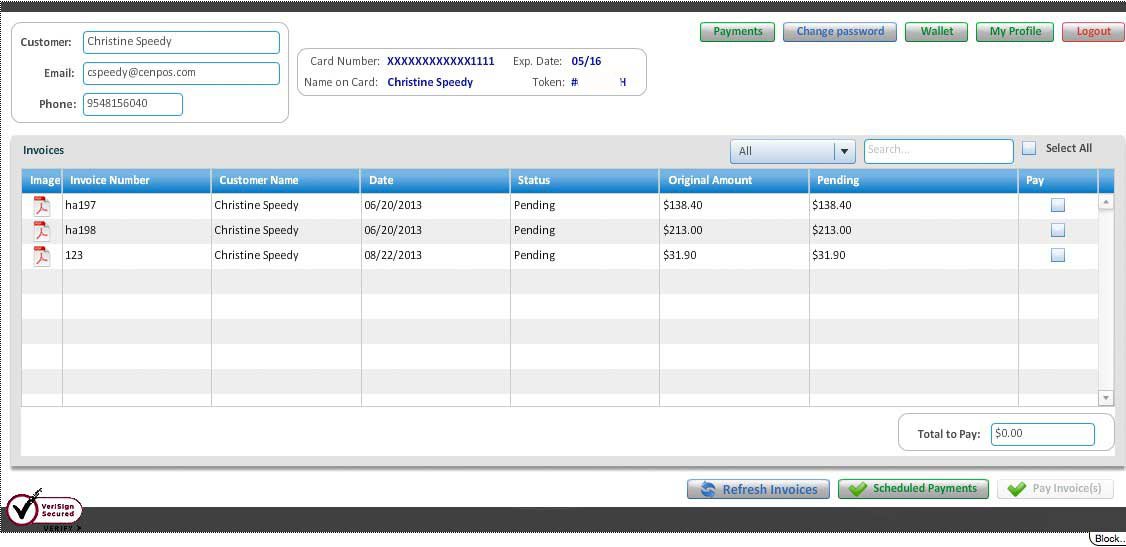
Yes, your customers can pay one invoice sent from an email without logging in to the invoice portal, or they can login and selected multiple invoices to pay. Our integrated payments module reduces customer friction to pay bills for Quickbooks Pro and Enterprise users and supports a variety of payment types and methods.

paying multiple invoices quickbooksNote, you must have your own desktop or hosted version of Quickbooks. Quickbooks online does not support the ability to add 3rd party modules.

Quickbooks Merchant Services Vs CenPOS Payment Gateway & Platform:

  • Quickbooks Intuit Merchant Services nets fees from every transaction; CenPOS fees are charged once per month.
  •  Intuit Merchant Services must use their acquirer. With CenPOS, choose any acquirer.
  • Quickbooks ACH nets their fees from every transaction. CenPOS fees are charged once per month.
  • Quickbooks sends monthly statements; CenPOS sends invoice reminders on your schedule with simple click to pay.
  • CenPOS supports level 3 processing and cardholder authentication to help you manage the cost of accepting credit cards and mitigate risk of chargebacks.

Christine Speedy, CenPOS business development 954-942-0483. CenPOS is a cloud based business solutions provider. Our cross-generational platform enables clients to expand their payment acceptance strategies, improve customer engagement, and increase business productivity.

Data breach prevention: update every device due to Intel vulnerability

News of the Intel chip flaw creating vulnerability in virtually everything with a computer chip in it was announced last week. Microsoft, Google and tech companies now have a fix so it’s time to update all your devices. These emergency updates are to address the bugs called Meltdown and Spectre.

“These hardware bugs allow programs to steal data which is currently processed on the computer. While programs are typically not permitted to read data from other programs, a malicious program can exploit Meltdown and Spectre to get hold of secrets stored in the memory of other running programs. This might include your passwords stored in a password manager or browser, your personal photos, emails, instant messages and even business-critical documents.”

“Meltdown and Spectre work on personal computers, mobile devices, and in the cloud. Depending on the cloud provider’s infrastructure, it might be possible to steal data from other customers.”

For PCI compliance, merchants must update software within 30 days, however, I wouldn’t wait. Prioritize updates now.

For more information on the bugs, see https://krebsonsecurity.com/2018/01/scary-chip-flaws-raise-spectre-of-meltdown/

Christine Speedy, CenPOS authorized reseller, 954-942-0483. CenPOS is a merchant-centric, end-to-end payments engine that drives enterprise-class solutions for businesses, saving them time and money, while improving their customer engagement. CenPOS secure, cloud-based solution optimizes acceptance for all payment types across multiple channels without disrupting the merchant’s banking relationships.

CenPOS Hosted Pay Page vs EBPP

I’m advising my CenPOS clients with card not present transactions to use either the hosted pay page or Electronic Bill Presentment and Payment (EBPP), also known as electronic invoice presentment and payment (EIPP) due to increasingly complex rules. Plus cardholders are weary about giving out card data over the phone, and paper or digital credit card authorization forms should be abolished. Reducing friction to collect payments, while putting cardholders in control of their data, is proven to increase sales, profits and cashflow so updating procedures is a win win for you and your customers.

What is a hosted pay page?

A hosted pay enables customers to passively pay bills online via a secure web page hosted on a CenPOS server. The form can be embedded on your web site secured with an SSL certificate or you can direct customers to your custom CenPOS URL. The most common payment types CenPOS users enable are credit cards, Paypal, and ACH (echeck).

  • The burden for completing data fields to make a payment is on your customer.
  • Customers can optionally create an account and store and manage all payment methods.
  • Depending on your customer agreement, either you or the customer can use a stored token on file to initiate future transactions.
  • Customers can view prior payment history, but not actual invoices.

What is EBPP?

With EBPP, the payment request is delivered to the customer via email or text. The message includes a custom link to pay a specific bill or invoice and some of the fields are pre-filled. Customers prefer EBPP vs hosted pay page. The most common payment types CenPOS users enable are credit cards, Paypal, ACH (echeck) and wire transfer. The last is very important for international businesses to streamline bank reconciliation and match deposits to invoices.

  • Data fields, including invoice number and amount, are pre-filled to save your customer time.
  • Customers can optionally create an account to store card data, pay multiple invoices, review payment and invoice history in the CenPOS hosted portal.
  • Depending on your agreement with your customer, either you or the customer can use a stored token on file to initiate future transactions.
  • With a CenPOS ERP or accounting software integration, your records are automatically updated with payments, and reminders are automatically delivered.
  • Optional 2-way texting service has many benefits, including communicating with customers via their preferred methods- whether phone, text or email.

What are the benefits of customer initiated payments with hosted pay page or EBPP?

  • Increased efficiency to comply with new stored credential rules.
  • Reduced merchant fees for some cards (3-D Secure cardholder authentication must be enabled.)
  • Increased approvals with cardholder authentication.
  • Mitigate chargeback risk – with cardholder authentication fraud liability shifts to issuer.

In summary, either method of online payments increases security and enables customers to pay 24/7 to increase cash flow. EBPP solutions have significant additional benefits and the cost to implement is virtually nil, with many businesses experiencing an instant ROI.

Christine Speedy, CenPOS authorized reseller, 954-942-0483. CenPOS is a merchant-centric, end-to-end payments engine that drives enterprise-class solutions for businesses, saving them time and money, while improving their customer engagement. CenPOS secure, cloud-based solution optimizes acceptance for all payment types across multiple channels without disrupting the merchant’s banking relationships.