Posts Tagged ‘mastercard’

Mastercard Dues and Assessments and Cross Border Fees update

Thursday, May 10th, 2012

Merchant statements for April 2012 may include a bulletin about fees. This is a bulletin from an actual statement.

EFFECTIVE WITH MAY 1, 2012, YOU WILL BE CHARGED DUES AND ASSESSMENT FEES WHICH SHALL BE CALCULATED AS FOLLOWS: 0.110% (MASTERCARD) APPLIED TO ALL SETTLED MASTERCARD CONSUMER AND COMMERCIAL CARD SALES BELOW $1,000 AS WELL AS PREPAID AND SIGNATURE DEBIT CARD SALES REGARDLESS OF THE TRANSACTION AMOUNT, 0.13% (MASTERCARD) APPLIED TO CONSUMER CREDIT AND COMMERCIAL CARD TRANSACTIONS EQUAL TO OR GREATER THAN $1,000, 0.110% (VISA) AND 0.105% (DISCOVER) MULTIPLIED BY YOUR GROSS SALES VOLUME. CONTINUING YOUR MERCHANT ACCOUNT WITH US OR USE OF YOUR MERCHANT ACCOUNT AFTER 30 DAYS WILL REPRESENT YOUR ACCEPTANCE TO THESE TERMS.

EFFECTIVE JUNE 1, 2012, YOUR MASTERCARD “US CROSS BORDER FEE” WILL BE INCREASED TO .40%.

EFFECTIVE JUNE 1, 2012, A .80% MASTERCARD “US CROSS BORDER FEE” WILL BE ADDED TO YOUR ACCOUNT. THIS FEE WILL BE APPLIED TO TRANSACTIONS IN WHICH THE CARD PRESENTED WAS ISSUED IN A COUNTRY OTHER THAN THE UNITED STATES.

All of the fees above are mandatory and non-negotiable. Merchants see these fees on their statements if they are on PASS THROUGH or INTERCHANGE PLUS pricing. We call this ‘wholesale’ pricing. This is the best price plan for merchants because costs are transparent. If the merchant does not have these fees itemized, then they are on a bundled price plan. The downside is that higher profits can be hidden in bundled pricing.

Note, cross border fees are fairly new, yet they are climbing rapidly. Some merchants are under the misconception that these fees do not apply to them with their particular merchant processor, however, if you read the fine print, you’ll find them everywhere. For example, Paypal charges a 1% cross border fee. Why the difference? Because it’s Paypal cross border, not card association specific ie Discover, Visa, MasterCard which each have their own rates. Paypal is a bundled price program. They can charge whatever they want.

MasterCard interchange rates and criteria update April 2012

Monday, May 7th, 2012

MasterCard updated their merchant interchange rates and fees portion of their web site. It’s a useful for all merchants. The missing link to all this data however  is a clear identification of which transactions are qualified and which ones are not.  For example, if a merchant is on Interchange plus pricing, it lists all the interchange rates the merchant paid. But it doesn’t indicate which ones are qualified and which ones downgraded to a higher rate. Some processors provide this information, with a section call ‘non-qualified’ transactions, however, the software frequently shows transactions as non-qualified that truly are the best qualified rate that a merchant can receive.

As a merchant I would want to know which rates are the best possible for a given card type at a glance. Why should a merchant have to hunt through hundreds of pages to figure it out? Interchange is not getting less complicated. Our team offers merchants an automated solution to qualify transactions for the best interchanges rates. Contact us for details.

3D Merchant maintains a list and links of all official interchange rates here.

MasterCard new annual merchant fee excludes pin-debit volume

Monday, February 27th, 2012

Following Visa’s new merchant fee announcement, MasterCard will launch a new annual fee for acquirers on July 1, 2012. No specifics of the fee has been released, however, it will be based on credit-card volume and pin-debit volume will be excluded from the calculation.

Once again, CenPOS retail customers will have another advantage at escaping increased fees. CenPOS pin debit conversion rate averages over 75% across all USA markets. Pin-debit also mitigates merchant risk with only a 14 day window for consumer disputes vs 120 days for signature debit.

About CenPOS : “Creating efficiencies through payment innovation”

Founded in 2009, Miami-based CenPOS is a payment technology provider committed to providing its customers and partners with innovative solutions for today’s rapidly evolving consumer payment choices. CenPOS is an intelligent payment-processing network that streamlines the payment experience for businesses and consumers by using state-of-the-art technology to replace inefficient, outdated payment systems.

CenPOS sales: Christine Speedy direct (954)942-0483


Merchant methods to leverage US vs Visa, Mastercard settlement

Sunday, July 24th, 2011

How can merchants use the US vs Visa and MasterCard settlement to lower  costs and improve EBITDA? Most believe the most critical element to any solution is knowing exactly what merchant fees are for cards presented. Thus while the settlement is a huge win for merchants, The Federal Reserve Bank of Boston concludes merchants do not likely have the information or capability to fully take advantage of the new rules. IN this article I’ll review how merchants can use our CenPOS technology to leverage the new rules, without needing  to decipher the interchange rate for every transaction in real time.

Note that American Express did not participate in the settlement, thus any suggestions do not apply for their brand.

This is an excellent article and I recommend reading it. Federal Reserve Bank of Boston Public Policy Discussion: An Economic Analysis of the 2010 Proposed Settlement between the Department of Justice and Credit Card Networks. Excerpts:

In 2010, the Department of Justice (DOJ) filed a lawsuit against the credit card networks American Express, MasterCard, and Visa for alleged antitrust violations. We evaluate the extent to which the recently proposed settlement between the DOJ and Visa and MasterCard is likely to achieve its central objective: “…to allow Merchants to attempt to influence the General Purpose [Credit] Card or Form of Payment Customers select by providing choices and information in a competitive market.” In word and spirit, the Proposed Settlement represents a significant step toward promoting competition in the credit card market. However, we find that merchants are unlikely to be able to take full advantage of the Proposed Settlement’s new freedoms because they currently lack comprehensible and complete information on the full and exact merchant discount fees for their customers’ credit cards.

The basic problem is that merchants currently lack sufficient information to disclose fees or differentiate their prices according to the method of payment. In theory, the Proposed Settlement would allow merchants to try to steer consumers toward lower-cost payment instruments by disclosing the fees merchants incur in accepting payment cards, and by offering enhanced discounts. In practice, however, merchants may not be able to use these privileges effectively because they may not know the exact merchant fee on each credit card until long after the transaction has taken place, and even then merchants typically learn only their aggregate monthly fees and not the specific fee for accepting a given card. Interchange fees—which account for the bulk of merchant fees—range from below 1 percent to over 3 percent. Merchants may be aware of this range, but they currently do not have all of the information they need to enable them to match an individual credit card presented by a consumer to the corresponding merchant fee for that card. Therefore, merchants would not be able to disclose the relevant card fees to their customers or to completely and accurately differentiate prices across payment instruments.

If merchants had the necessary information in real time (that is, at or before the time of the transaction) to facilitate the mapping of cards and fees, under the Proposed Settlement they could attempt to steer customers toward lower-cost payment methods. However, merchants would still be restricted in the mechanisms they could use to this end because the Proposed Settlement did not challenge the Visa and MasterCard rule that prohibits merchants from imposing surcharges that reflect the costs they incur in processing payments.

End excerpts.

The new rules, together with Dodd–Frank Wall Street Reform and Consumer Protection Act, empower merchants with new flexibility to manage costs. The industry response is that only the biggest of merchants can benefit from the settlement. But that’s not true. Our technology enables merchants to provide discounts right now.

Ideas to reduce payment processing costs based on new rules:

  1. Check your merchant agreement schedule A. Does it state anywhere on the agreement “pass through interchange”. If not, your options to reduce fees may be limited.
  2. Put up a sign for a minimum charge amount. (Minimum cannot apply to debit cards.)
  3. Put up a sign informing customers of really basic information. For example,  you could put up a sign “Please help us keep costs low by using your debit or check card. For every $100 sale our costs average: Cash $0, Debit/ check card $.90, credit card $1.85, rewards card $2.50.”
  4. Implement our CenPOS technology and offer discounts based on rules you set. For example, do you want to offer a percent or a flat amount? Do you want to offer the rule only if they use one card brand such as Visa? Only over a certain amount? Only on certain days? The options are endless and can be remotely managed in real time, completely removing cashiers from any part of the discount process.
  5. Identify your average ticket and average cost per transaction. Test and measure different incentives to customers using CenPOS.
  6. Implement CenPOS technology in a retail setting and steer customers to enter their pin number, reducing risk of chargebacks. The 2010 national average for pin debit penetration was less than 29%; CenPOS users averaged 74%.

Considerations for offering incentives of any type or payment steering.

  • Do you know what percent of your transactions are debit right now?
  • Do you know what percent of your transactions are any type of card right now?
  • Do you know your average cost per transaction on debit? On other card types?
  • Do you know if card type usage is cyclical by time of day, day of week, location of your facility, or how payment is accepted (retail, online etc)

CenPOS technology provides real time information about all of the above so you can manage how and what type of discounts to offer. Merchants can use integrated check and ACH services with CenPOS.

CENPOS SALES: Call the credit card processing hotline at the top of the page for direct merchant sales, ISO sales, and other 3rd party reseller sales.


US Justice Dept enters final judgement with Visa, Mastercard

Saturday, July 23rd, 2011

July 20, 2011, The United States of America, and other states, announced a final settlement in US vs MasterCard International Inc., and Visa Inc. The antitrust lawsuit said that MasterCard and Visa have rules in place that prevent merchants from offering consumers discounts, rewards and information about card costs, ultimately resulting in consumers paying more for their purchases.

In summary of the settlement, the purpose is to allow merchants to influence consumer payment choices by disclosing information about their costs for using different cards. Merchants can:
- Offer a rebate or discount at the point of sale for using a particular brand or card type, or form of payment.
- Offer a free product at the point of sale for using a particular brand or card type, or form of payment.
- Offer a free, enhanced, or discounted service or at the point of sale for using a particular brand or card type, or form of payment.
- Offer incentives or other benefits.
- Express a preference for different card or payment types.
- Communicate how much it costs them to accept different payment types.

Interestingly, nothing shall prevent a merchant from disparaging either brand.

US Visa International Operating Rules and MasterCard Rules must be updated within 5 days to reflect the new language included in the settlement.

JUSTICE DEPARTMENT SUES AMERICAN EXPRESS, MASTERCARD AND VISA

Saturday, July 23rd, 2011

JUSTICE DEPARTMENT SUES AMERICAN EXPRESS, MASTERCARD AND VISA TO ELIMINATE RULES RESTRICTING PRICE COMPETITION; REACHES SETTLEMENT WITH VISA AND MASTERCARD

Department to Litigate Against American Express to Promote Competition Among Credit
Card Networks Enabling Merchants to Benefit Consumers

MONDAY, OCTOBER 4, 2010 WWW.JUSTICE.GOV

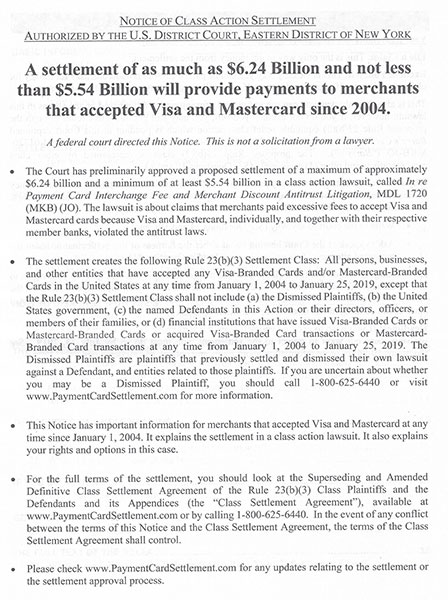
WASHINGTON — The Department of Justice announced today that it filed a civil antitrust lawsuit in U.S. District Court for the Eastern District of New York challenging rules that American Express, MasterCard and Visa have in place that prevent merchants from offering consumers discounts, rewards and information about card costs, ultimately resulting in consumers paying more for their purchases. The department also said that the rules increase merchants’ costs of doing business. Joining the department in its lawsuit are the states of Connecticut, Iowa, Maryland, Michigan, Missouri, Ohio and Texas.

At the same time, the department announced that it has filed a proposed settlement with Visa and MasterCard, that, if approved by the court, would require the two companies to allow merchants to offer discounts, incentives, and information to consumers to encourage the use of payment methods that are less costly.

According to the complaint, American Express, MasterCard and Visa maintain rules that prohibit merchants from encouraging consumers to use lower-cost payment methods when making purchases. For example, the rules prohibit merchants from offering discounts or other incentives to consumers in order to encourage them to pay with credit cards that cost the merchant less to accept.

“With today’s lawsuit we are sending a clear message: We will not tolerate anticompetitive practices,” said Attorney General Eric Holder. “We want to put more money in consumers’ pockets, and by eliminating credit card companies’ anticompetitive rules, we will accomplish that.”

“These restrictive rules restrain competition among credit card networks for merchant acceptance and distort the competitive process,” said Christine Varney, Assistant Attorney General in charge of the Department of Justice’s Antitrust Division. “The proposed settlement with MasterCard and Visa is an important step in bringing more credit card competition to the point of sale. The department’s lawsuit against American Express will continue that effort and, if successful, allow merchants more freedom to benefit their customers.”

Credit card acceptance costs U.S. merchants approximately $35 billion each year. Those costs are collected from merchants in the form of a “swipe fee” they pay every time a credit card is used. American Express has the highest merchant fees of any credit card network. Merchants pass on these billions of dollars in fees to all their consumers in the form of higher retail prices. By preventing merchants from rewarding consumers when they use less expensive credit cards to make a purchase, American Express, MasterCard and Visa have inhibited merchants’ ability to reduce card acceptance costs, and therefore their retail prices to consumers.

The proposed settlement requires MasterCard and Visa to allow their merchants to:

Offer consumers an immediate discount or rebate or a free or discounted product or service for using a particular credit card network, low-cost card within that network or other form of payment;
Express a preference for the use of a particular credit card network, low-cost card within that network or other form of payment;
Promote a particular credit card network, low-cost card within that network or other form of payment through posted information or other communications to consumers; and
Communicate to consumers the cost incurred by the merchant when a consumer uses a particular credit card network, type of card within that network, or other form of payment.
The proposed settlement allows any merchant that only accepts Visa and MasterCard to take advantage of the relief immediately.

The ongoing litigation against American Express seeks to allow merchants that accept American Express to engage in the same kind of discounting and encouragement that the proposed settlement with MasterCard and Visa allows. Until American Express’s restraints on merchants are lifted, the many merchants that accept American Express, as well as Visa and MasterCard, will not be able to take full advantage of their new options under the proposed settlement, the department said.

American Express Company, the parent of American Express Travel Related Services Company Inc., is a New York corporation, with its principal place of business in New York City. Cardholders used American Express credit and charge cards for $419.8 billion in purchases in 2009. MasterCard is a Delaware corporation with its principal place of business in Purchase, New York. Cardholders used MasterCard credit and charge cards for $476.9 billion in purchases in 2009. Visa is a Delaware corporation with its principal place of business in San Francisco. Cardholders used Visa credit and charge cards for $764.2 billion in purchases in 2009.

The proposed settlement, along with the department’s competitive impact statement, will be published in The Federal Register, as required by the Antitrust Procedures and Penalties Act. Any person may submit written comments concerning the proposed settlement within 60 days of its publication to John R. Read, Chief, Litigation III Section, Antitrust Division, U.S. Department of Justice, 450 Fifth Street N.W., Suite 4000, Washington D.C. 20530. At the conclusion of the 60-day comment period, the court may enter the final judgment as to MasterCard and Visa only upon a finding that it serves the public interest.

The court will determine a pretrial schedule for the case against American Express once American Express files its response to the government’s lawsuit.

# # #

What merchants and consumers need to know about Google Wallet

Wednesday, June 1st, 2011

For businesses and consumers, we share with you some insights in our Google Wallet review.  What you need to use it, what it will cost, and our recommendation.

For consumers to use Google Wallet to pay at checkout you will need ALL of these elements:

google wallet phone citi paypass

  1. Download Google Wallet free app.
  2. A Citi MasterCard credit card with Paypass capability.
  3. An app-specific activation PIN that you must get from Citi.
  4. Sprint Nexus S 4G with tamper proof chip, dubbed the “secure element” by Google.  (In the first release, all payment card credentials will be encrypted and stored on a chip, called the secure element, that is separate from the Android device memory and is only accessible by authorized programs.)
  5. A merchant that with equipment enabled for Paypass.

If you have all of the above, then instead of whipping out your credit card, you’ll be able to enter your PIN number to enable or ‘open’ the application, then wave in front of the merchant Paypass reader.

If you have not registered your MasterCard credit card with Paypass capability to use with the Google Wallet,  you can still charge up to $100 if you have all the other elements complete.

For merchants to accept Google Wallet at checkout you’ll need a terminal capable of accepting Paypass. This is typically an add-on option for many signature capture terminals.

Card present interchange rates will apply.

BACKGROUND:

  1. Google Wallet is currently field testing, but will become available to consumers this summer.
  2. Google Wallet stores virtual versions of credit cards and coupons on a phone.
  3. It will also store loyalty and gift cards in the future.
  4. Google Wallet is separate from Google Checkout, and can be thought of as the brick-and-mortar counterpart to the online payment nature of Google Checkout.
  5. At first, Google Wallet will only be available on the Nexus S 4G by Google from Sprint, but Google will expand it to other devices/platforms in time.
  6. Google Wallet will support Citi PayPass eligible MasterCard credit cards and the Google prepaid card upon launch, but will support more in the future.
  7. Users can pay with Google Wallet anywhere MasterCard PayPass is accepted, currently about 124,000 PayPass-enabled merchants nationally. These include American Eagle Outfitters, Bloomingdale’s, Champs Sports, The Container Store, Duane Reade, Einstein Bros. Bagels, Foot Locker, Guess, Jamba Juice, Macy’s, Noah’s Bagels, Peet’s Coffee & Tea, RadioShack, Subway, Toys“R”Us and Walgreens.

COMMENTS:

What does it cost merchants to accept MasterCard PayPass cards? It will depend on the interchange qualification. Paypass can be added to any US account holder.  Citi is promoting two CitiCards with paypass online. They are both rewards cards.  World Elite Merit 3 Base is most likely the qualified interchange rate for those cards which is 2.2% and $.10 per transaction. This is at the top of the range for consumer credit card interchange rates, which start as low as 1.05% for MasterCard debit.  As a merchant,  they currently get nothing in return for accepting Paypass cards now. With Google Wallet, there is the opportunity to get value with coupons and other features offered. About 60% of MasterCard transactions are rewards cards and the balance debit in basic retail operations.

Here’s why I won’t be getting a Google Wallet now and probably never:

I’m definitely a techie and an early adopter of some tech products.

  • I don’t have a Paypass.  Like most Americans, I use Visa more than MasterCard,  by about a 3:1 margin. (Note: changing credit cards regularly can lower your credit score, causing an increase in insurance premiums and other items.)
  • I don’t have the Sprint Nexus. I use an iPhone and I’ll never switch to Sprint even if I change phones. (Though AT&T could buy Sprint making that a moot point. )
  • As a consumer, I don’t buy the fact that this will replace my wallet. I’ll always need to carry my drivers license, therefore I’ll always have my wallet.
  • Big Brother Google.  Google won’t have access to my specific purchases (or so they say) but there are multiple points of data collecting and data pushing going on by multiple parties in order to send me timely offers etc. The is  largely unregulated terrain with unknown future consequences. Sorry, but I’m not opening the door to make it easier to collect more data about me or my buying habits.

I am interested in new payment technology involving my cellphone, but this is not the one.

Merchant recommendations: If you’re not leveraging the value add of Google Wallet marketing features, then consider what is the ROI for adding new equipment to support it.

Consumers: If you already have a MasterCard and the phone, see if you can add Paypass to it. I’d still hold off a few months before adding Google Wallet though to wait and see what bugs are reported.

Related article
Google, Citi, MasterCard, First Data and Sprint team up to make your phone your wallet


Citi with Arc Design are registered service marks of Citigroup, Inc. MasterCard is a registered trademark and PayPass is a trademark of MasterCard International Incorporated.

MasterCard and Discover minimum maximum transaction limits

Friday, December 10th, 2010

MasterCard and Discover Card Brands Revise Minimum Transaction Amount Rules. Effective immediately, MasterCard and Discover announced a revision to their rules permitting Merchants the ability to set a minimum transaction amount of up to $10 on a Card Sale or Cash Advance when the purchase is made with a Credit Card (a card account that accesses a credit account) and does not differentiate between issuers or other card acceptance brands. Setting a minimum transaction amount limit for debit cards (Pin Debit or Signature Debit) is still prohibited

See related article Visa, MasterCard minimum transaction limit changes which highlights how this rule came about from the Durbin Amendment, passed and signed into law, July 2010.